From 1641 till his death in 1674, Pratap Malla (1624–1674 A.D.) was the eighth Malla king and the ruler of Kantipur. He made an unsuccessful attempt to take Lalitpur and Bhaktapur in order to unite the Kathmandu Valley. He was in charge of Kantipur’s monopoly on trade with Tibet and was effective in expanding and fortifying its borders. Most of the structures surrounding Durbar Square were built during his rule as a result of the ensuing prosperity. His rule is regarded as the Malla dynasty’s pinnacle of culture and prosperity.
The lute-playing Pratap Malla and his queen can be seen in the alcove above the gate of Hanuman Dhoka Palace.
On a column facing the palace in the square is a statue of Pratap Malla. The niche above the Hanuman Dhoka Palace gate also features his portrait. King Pratap Malla, playing a lute, and his queen are depicted in the niche above the gate, together with a more tender and passionate Krishna surrounded by gopinis. The image of Krishna is depicted in his fierce, tantric aspect.
Living
He was born to a Malla father, Lakshmi Narasinha Malla, and a Maithali mother. Pratap Malla possessed administrative skills even during his father’s lifetime. In 1641 A.D., he ascended to the throne and put his father in jail on charges of lunacy. He was an extremely aspirational monarch.
Getting married and having kids
From 1680 to 1687 CE, Parthibendra Malla, the son of Pratap Malla, governed Kathmandu.
The first of Pratap Malla’s queens was a Maithali woman from Southern Nepal, and the second was the sister of Zil-gnon dbang-rgyal rdo-rje, a well-known Tibetan Buddhist guru who had advised him. He has a reputation for being harem-keeping and obscene, according to several contemporary historians. Additionally, he is accused of raping a virgin girl, which ultimately led to her demise. It is reported that Pratap Malla was so deeply sorry for this deed that he sought to atone for his transgressions by consulting knowledgeable and wise men. Following their advice, he erected a statue of himself and his two queens beside hundreds of Lingas at Pashupati. In addition, he did Koti Hom, weighed himself on one scale and gold on another, and donated the results to charity. He also built a grazing ground close by and erected a pillar on Pashupati’s southern entrance to mark the occasion.
Bhupendra Malla, Chakrabartendra, Nripendra, Mahipatendra, and Parthibendra were Pratap Malla’s five sons. Even while he was still living, he wanted his sons to have experience in national governance. He made them take turns ruling the nation for a year in order to achieve this goal. Unfortunately, though, Chakrabartendra Malla, his second son, passed away the day after he assumed control of the nation’s government.
Relationships with Bhaktapur and Lalitpur
He frequently battled to annex Lalitpur and Bhaktapur to his realm, but he was never successful. He attempted to pit the monarchs of Bhaktapur and Lalitpur against one another. He occasionally sided with Bhaktapur and threatened Lalitpur. He occasionally fell on Bhaktapur after siding with Lalitpur. Annexing Lalitpur to Kathmandu was his primary goal. However, his goal was not accomplished since Ram Shah, the king of Gorkha, was an ally of the ruler of Lalitpur. In terms of bravery and diplomacy, Shree Nivas, son of Siddhi Nara Singha, was equally as good as Pratap Malla. When Siddhi Nara Singha Malla was performing Koti Hom in 1634 A.D., Pratap Malla took advantage of the situation and launched a surprise attack on Patan, taking control of several strategically significant locations. To aid Siddhi Nara Singh Malla, Dambar Shah, son of Ram Shah, had arrived with a detachment; however, his troops were routed and routed. Pratap Malla caused the King of Bhaktapur, Narendra Malla, a great deal of problems. He forced Narendra Malla to honor him by presenting him with elephants. He later joined Shree Niwas Malla once more and besieged Bhaktapur. He took several jewels with him when he pillaged Bhaktapur. However, Pratap Malla made a pact with Bhaktapur after Lalitpur joined Bhaktapur.
support for literature and the arts
Pratap Malla built Kabindrapur.
Pratap Malla has a passion for books. He was a poet himself. Kavindra, which translates to “the King of poets,” is the title he bestowed upon himself. He was accepting of all faiths. He enjoyed constructing temples. Beside his palace, he placed a picture of Hanuman. The palace has been known as “Hanuman Dhoka” ever since. In addition, he constructed a Guheshwari temple and a Krishna temple featuring the image of Kala Bhairav in front of Hanuman Dhoka. He presented the temple of Pashupatinath with a gold umbrella. He held Buddhism in high regard. Seto Machchhindranath Jatra was introduced by him.
Death
Pratap Malla passed away unexpectedly. He passed away after becoming asleep while attending the Harisiddhi religious dance. He ruled for 33 years before passing away in 1674. He ruled for thirty-three years (1641–1674), during which time there was no external threat and domestic stability and prosperity. Nepal became wealthy as a result of trade with China and India. Literature and the arts prospered. The rulers of neighboring kingdoms like Bhaktapur and Lalitpur were afraid to attack Kantipur. Nepalese culture peaked under Pratap Malla’s reign, much like Muslim culture did during Shah Jahan’s.
Tibet-related relations
Left: Tanguth Kingdom noble women’s attire. Center: Women’s attire in the vicinity of Cuthi, the Necbal kingdom’s capital. Right: The Kingdom of Necbal’s attire. “China Illustrata”
In terms of Nepal-Tibet ties, the 16th and 17th centuries were pivotal. The battle between rival Buddhist sects and the more fundamental regional strife between the two central Tibetan provinces—Lhasa and Shigatse are the political centers of these provinces—had left Tibet in a state of near-anarchy by 1600. With the invaluable help of the Khoshote Mongols, the Fifth Dalai Lama, the leader of the Gelugpa (yellow) sect of Tibetan Buddhism, gradually took temporal and spiritual authority of Tibet in the first half of the 17th century.
Two ambitious monarchs, Pratap Malla of Kantipur and Ram Shah of Gorkha (1606–33), exploited Tibetan weakness during this crucial time to take control of the crucial border-pass areas that were used by the majority of the trans-Himalayan trade. After capturing the area that separated Tibet’s Kirong district from Gorkha, Ram Shah launched his forays into Tibet at the conclusion of his rule, most likely between 1625 and 1630. The two leaders’ severed heads were sent to the Panchen Lama at Shigatse after the initial Gorkhali invasion force was routed. After leading a second army into the Kerong region, Ram Shah routed the Tibetans at Khinchog and made it as far as Kukurghat. Ram Shah gained control of one of the primary routes of communication between Nepal and Tibet when he and the Tibetans came to an arrangement that established the border between Gorkha and Tibet at Kukurghat.
For the Kathmandu merchant community, who typically used the route through Kirong in their trade with Tibet, this presented a significant challenge. Instead of directly challenging the Gorkha monarch for control of Kerong, Pratap Malla aimed to subjugate the second important trade route through Kuti. In the 1630s and again between 1645 and 1650, an army led by his brother, Bhim Malla, was dispatched to Kuti. The second time, Bhim Malla took control of the border territory and moved a little distance in the direction of Shigatse before being confronted by the Dalai Lama’s delegates, with whom he signed a peace agreement.
In brief, the following were the stipulations of this treaty:
- Tibet and Kathmandu were given joint control of the border towns of Kerong and Kuti.
- Thirty-two commercial houses were allowed to be established in Lhasa by the Kathmandu Valley’s Newari merchant community.
- The authority to send a delegate (Nayo) to Lhasa was granted to the Kathmandu court.
- Tibet promised not to charge Newari traders doing business with Tibet any fees or customs duties.
- Tibet agreed to give Kathmandu an annual token payment in gold and silver.
- It was decided that Nepal would mint coins for Tibet, which Tibet would use internally and either supply the silver needed to mint them or use gold to purchase Nepali coins.
- Tibet decided that all trade with India would go through the Kathmandu Valley rather than the eastern routes (through Sikkim, Bhutan, or Towang), even if it was carried out by merchants other than Newaris.
- The contract allowed the Kathmandu Valley’s merchants to expand their business operations to Lhasa and gave them a monopoly-like grip on the profitable trade between India and Tibet. Because he took a specific portion of the silver that Lhasa supplied as payment for his services, the king of Kathmandu also made a sizable profit from the method by which he produced coins for the Tibetan government. For over a century, these Nepali coins, known as “Mahendramalli,” were the only money in use in Tibet.
Visitors from Europe
Center and left. The Kingdom of Necbal’s attire. Yes. A tartar from the north. “China Illustrata”
Albert d’Orville and Johann Grueber, an Austrian and a Belgian, were welcomed into the valley by Pratap Malla, the King of Kathmandu at the time, in 1661. In search of a land passage to India, they were traveling via Lhasa from the imperial Chinese Observatory in Peking to Kathmandu. He gave them permission to preach the new faith, but they departed for Agra, the Tibet-Hindustan Mission’s headquarters in India, without waiting for authorization to remain permanently. They calculated Kathmandu’s latitude to be 27″5′, which is 37′ lower than the real latitude of 27″42″.
The first description of Nepal is provided to Europeans in Athanasius Kircher’s China Illustrata, which details their expedition. Despite the king’s gracious welcome, the book paints the following negative image of Nepal under Pratap Malla’s rule:
The voyage from Nesti to Cadmendu, the capital of the kingdom of Necbal, which is located at 27″5′ North, takes six days. The king who lives here is strong but a pagan who does not oppose Christian law. Cuthi and Nesti are the kingdom’s cities. In this tribe, it is not uncommon for men or women to pour out a glass of wine or tea three times for the first woman. They attach three bits of butter to the cup’s rim while they are sipping. They apply this butter to their foreheads afterwards. Here, they have another tradition that is terrifying in its savagery. People are tossed out of the house into the corpse-filled ditches of the field when they are near death and there is no chance that they will recover. These perish there without any devotional or mournful deeds, having been exposed to all the harms of nature. Once dead, these are left for wolves, dogs, birds of prey, and other animals to eat. They convince themselves that allowing the deceased to find a tomb in the intestines of live animals is a singularly magnificent monument. These kingdoms’ ladies are so hideous that they resemble devils more than people. For religious reasons, they only ever use completely rancid oil to wash themselves rather than water. In addition to releasing an unbearable stink, the oil has discolored them to the point where you would refer to them as ghouls rather than people.
Because of the telescope—which he had never heard of before—and the other scientific devices that were displayed to him, the monarch gave the fathers a great deal of kindness. In fact, he was so enthralled with these things that he chose to keep the fathers with him; if they hadn’t made a commitment to return, they would not have been permitted to leave. He promised to provide plenty of revenue and to build a residence there for our use and the missionary activity of our order if they did this. Additionally, he fully approved the introduction of the Law of Christ into his dominion.
However, most of these statements are not supported by research. According to Tribhuwan University historians, these fictitious records may have been created by missionaries to present Christianity in a more beautiful light by denigrating the religion practiced in the kingdom and depicting it as barbarous.
Legacy
Temple of Krishna (Chyasin Dega)
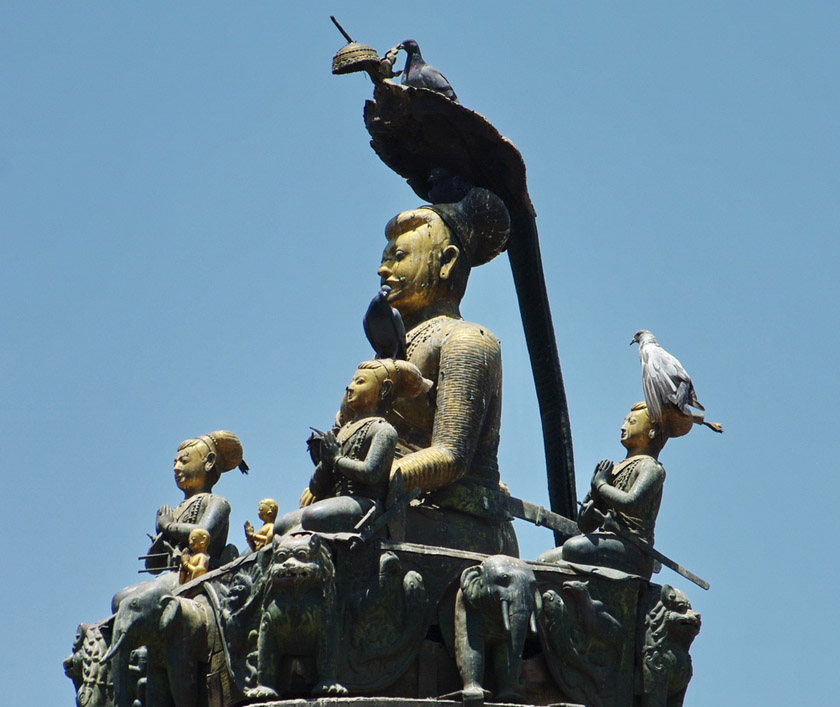
Hanuman Dhoka Palace’s statue of Pratap Malla with his sons and wives.
Pratap Malla constructed the octagonal Krishna Temple around 1648–1649, perhaps in remembrance of his two wives, in reaction to competitor Siddhinarshingh Malla’s Krishna Temple in Patan, or as a religious solace for his previous failure to subjugate that city. Around the base of the three-tiered traditional Newari building are stone columns that support it. According to a Sanskrit inscription, the picture of Krishna inside the temple is joined by his two brides, Satyabhama and Rukmini, who purposefully resemble Pratap Malla and his own two queens. The pictures of Krishna and two goddesses inside are said to be based on the monarch and his two wives, according to a Sanskrit inscription.
Malla Pratap’s Column
The Pratap Dhvaja, a square stone pillar, is located across from the Krishna Temple, on a slightly elevated platform in front of the Hanuman Dhoka. A statue of King Pratap Malla sitting with his hands folded and encircled by his two wives and five sons—including a baby—stands atop it. On the third floor of the Degutaleju Temple, he gazes at his personal prayer chamber. Prior to the comparable columns in Patan and Bhaktapur, the column was constructed in 1670 by Pratap Malla.
Statue of Kal Bhairab
Shiva in his destructive form is shown by the Kalbhairav statue in Hanuman Dhoka Durbar Square.
The stone inscription of Pratap Malla in Durbar Square, Kathmandu. The word “winter” appears here.
Kala Bhairab is located to the north of the Jagannath Temple. In his most frightening form, Bhairab is Shiva. This enormous stone statue of the dreadful Kal Bhairab has six arms, tramples on a corpse, and wears a garland of skulls, all of which represent human stupidity. Pratap Malla is credited with bringing the figure to its current site after it was discovered in a field north of the city. The upper left corner of the image has since been fixed, however it was originally cut from a single stone. Lying in front of Kala Bhairab is claimed to result in immediate death and was formerly employed as a trial by ordeal.
Inscription on stone
There is a lengthy, low stone inscription to the goddess Kalika on the outside of Kathmandu Durbar’s white wall, across from the Vishnu Temple. It is written in fifteen different languages, including European ones. This inscription was created on January 14, 1664, by Pratap Malla, who was well-known for his linguistic skills. According to a tradition, if someone can figure out all fifteen languages, milk will pour from the central spout.
Fr. provides an account of the wall and the inscription. At the close of the eighteenth century, Giuseppe wrote:
In one of the walls of the royal palace of Kathmandu, which is situated on the court in front of the palace, there is a large stone that is about fifteen feet long and four or five feet thick. It has four square holes on top of it that are spaced equally apart. Water is poured into the holes in the wall, and each hole has a closed canal at the courtside, so everyone can have water to drink. There is a big ladder at the base of the stone that people use to climb up and get a drink, but what makes the stone interesting is how many different languages have been carved into it. There is a line of Roman characters in the middle that reads AVTOMNE WINTER LHIVERT. However, none of the locals know how they got there or whether any Europeans had ever been in Nepal before the missionaries, who only arrived at the beginning of the current century. Other lines contain the characters of the country’s language, others the characters of Tibet, Persia, Greece, and several others of other countries. Clearly, there is an English term in between the two French titles for the seasons.
The seasons are called AVTOMNE (autumn) and L’HIVERT (winter) in French. In German or Dutch, the word “WINTER” could also mean “winter.”
Rani Pokhari
Ghantaghar (clock tower) and Trichandra College are in the background of Ranipokhari, which Pratap Malla commissioned in 1667.
Children costumed as cows at the Gai Jatra festival in 2011.
Situated in the center of Kathmandu, Ranipokhari is a fifteen-minute walk from Kathmandu Durbar Square. The manmade square pond with the Shiva temple in the center is called Rani Pokhari, or Queen’s Pond. The Rani in question was the queen of Pratap Malla, who in 1667 ordered it built in honor of their son, Chakravatendra Malla, who died on the second day of his reign, presumably after being trampled underfoot by an elephant, after his father abdicated in favor of his four sons, each of whom would rule for a year.
The pond’s holiness was guaranteed by the fact that the water used to fill it came from 51 holy rivers in India and Nepal. The temple in the center of the pond is topped by a copper spire and features a domed roof evoking traditional Indian Mughal architecture. Other gods are depicted, but the Shiva lingam is the primary figure. Bhirab, Harishankar, Shakti, and Tarkeshwari are shown in four little temples in each corner. A statue of an elephant on the southern embankment is believed to be carrying three male members of the Pratap Malla family on its back, with a fourth person being held in its trunk.
Over time, Rani Pokhari has become linked to a number of tales and legends. It is claimed to be plagued by ghosts, one particularly alluring female specter that even the legendary Pratap Malla found unsettling.
The pond, which is walled with iron bars, is opened once a year on Bhaitika, the fifth and last day of Tihar, presumably to avoid drowning suicide.
Jatra Gai
Pratap Malla built the white spire temples of Anantapur and Pratapur in the Swayambhu complex in 1646.
King Pratap Malla’s wife, the queen, was still in mourning after the death of his son. The state of his beloved queen saddened the monarch much. Despite numerous attempts, the monarch was unable to ease his wife’s sorrow. He said that anyone who made the queen laugh would receive a suitable award because he so much wanted to see a small grin on her lips. The grieving queen was shown the cow procession during the Gai Jatra celebration. The attendees then started making fun of and making fun of the prominent members of society. Ultimately, the queen couldn’t help but smile when the social inequities and other evils were brought to light and brutally attacked. The king established a custom of incorporating jokes, satire, ridicule, and lampoon into the Gaijatra festival when the queen laughed. According to the customs, each family that lost a family member in the previous year takes part in a parade through the streets while pulling a cow. A young boy costumed as a cow is used in place of a cow if one is not available.
Swayambhunath
During Pratap Malla’s rule in 1614, Zhamarpa VI added to and renovated the Swayambhunath complex. A bridge across the Vishnumati and a lengthy stairway were built to increase access from Kathmandu. Three painted images representing the Three Precious Jewels of Buddhism, which were constructed in 1637 by Pratap Malla and his son Lakshmandra Singh Malla, are located at the base of the 400 stone steps.
Additionally, Pratap Malla positioned a sizable vajra in front of the stupa. He also constructed two white shikhar (spires) temples, Anantapur (southeast) and Pratapur (northeast), to flank the vajra. These temples were constructed in 1646 to house the guardian deities Bhairab and Bhairabi.
Great Article