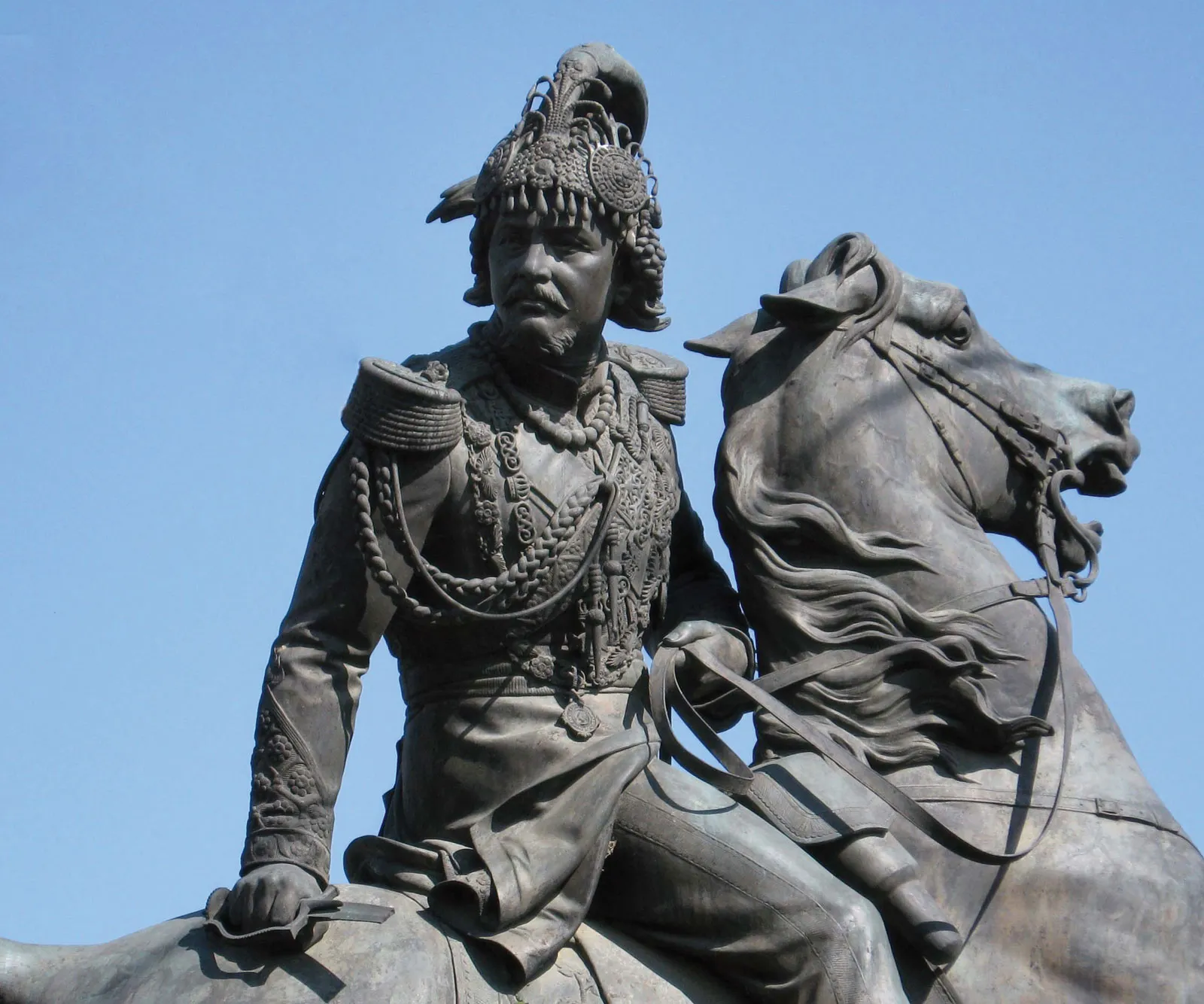
Bir Narsingh Kunwar (1817–1877) was the birthplace of Jung Bahadur Rana, GCB, GCSI. Ganesh Kumari, his mother, was the daughter of Kaji Nain Singh Thapa, a member of the well-known Thapa family and the brother of Mukhtiyar Bhimsen Thapa. During his lifetime, Jung Bahadur brought reforms to the bureaucracy and judiciary, eradicated factional strife at court, drove out his family’s adversaries, including the Pandes and Basnyats, and worked to modernize Nepal. In Nepalese history, he is regarded as an important character. While some contemporary historians ascribe this time to Jung Bahadur’s nephews, the Shumsher Ranas, others blame him for starting a dark phase in Nepalese history that was characterized by a repressive tyranny that lasted 104 years. Tyranny, drunkenness, economic exploitation, and religious persecution are frequently linked to Rana’s leadership.
His maternal uncle, Mathabar Singh Thapa, gave him the nickname Jung Bahadur, although his given name was Bir Narsingh Kunwar.
Childhood and family
Article focus: Rana dynasty
Additional details: Pande family and Thapa dynasty
Birth
On June 18, 1817, Jung Bahadur was born in Balkot, in southern Nepal. He was the son of King Rana Bahadur Shah’s bodyguard Bal Narsingh Kunwar and Ganesh Kumari, his second wife.
Family
Kaji Ranajit Kunwar and Sardar Ram Krishna Kunwar, two important military leaders under King Prithvi Narayan Shah, were the ancestors of Jung Bahadur. Additionally, he was related to the aristocratic Pande family through his maternal grandmother, Rana Kumari, who was the daughter of renowned royal courtier Kaji Ranajit Pande, and to the Thapa dynasty with Mukhtiyar Bhimsen Thapa through his mother, Ganesh Kumari.
Bal Narsingh was present when the king’s half-brother, Sher Bahadur Shah, committed regicide in front of the court. Bal Narsingh swiftly put Sher Bahadur to death in retaliation. He received the inherited title of Kaji as compensation for this deed. Consequently, the court gave Bal Narsingh the only right to carry firearms on company property.
Jung Bahadur’s great-grandfather, Ram Krishna Kunwar
Ganesh Kumari, Rana’s mother, was Mathabarsingh Thapa’s sister. After relocating to Dadeldhura in Western Nepal in 1833, Bal Narsingh enlisted Jung Bahadur in the army. Jung Bahadur was already given a promotion to second lieutenant by the time Bal Narsingh moved to Jumla in 1835. The Thapas had considerable control over Nepal’s governance during this time. However, all of Bhimsen Thapa’s relatives—including Bal Narsingh and Jung Bahadur—were fired from their jobs and had their property stolen when he was fired in 1837. Jung Bahadur traveled to Varanasi in pursuit of employment, but he soon returned to Terai to work as a Mahout. In 1839, after the deaths of his wife and young son, he relocated to Kathmandu.
Rise
Jung Bahadur wed Colonel Sanak Singh Shripali Tandon’s sister in 1839. His financial circumstances were enhanced by the dowry from this marriage. When King Rajendra visited Terai in 1840, he happened to run into Jung Bahadur. The monarch was thrilled with Jung Bahadur’s bold performance. The monarch elevated him to the rank of captain after being pleased with his performance. Jung Bahadur was then enlisted by the Crown Prince to serve as one of his personal guardians. Legend has it that, at the Prince’s command, Jung Bahadur jumped into the Trishuli River on horseback.
Jung Bahadur was eventually moved back to the king’s group from the prince’s. He was given the position of Kumarichowk after being appointed as a Kaji. He had the chance to fully comprehend Nepal’s financial operations in this role.
Jung Bahadur has a reputation for being ambitious. At that time, the king had merely a ceremonial role as the country’s ruler; the youngest queen was in charge. The person who was closest to the queen was Gagan Singh Khawas. Through his hard work, Jung Bahadur was able to get the approval of the prime minister, the queen, and the prince. Henry Lawrence and his wife, Honoria Lawrence, were also influenced by him.
Jung Bahadur’s relative received a death sentence while Mathabar Singh Thapa was still prime minister. Mathabar turned down Jung Bahadur’s appeal to convince the queen to forgive his cousin. Jung Bahadur became resentful of him as a result of this rejection. After becoming friends with Pandit Bijayaraj, the palace’s internal priest, Jung Bahadur started learning important details about the Durbar. Additionally, he was able to make friends with Gagan Singh Khawas.
The queen appointed Gagan Singh to the council of ministers and elevated Jung Bahadur to the rank of General following the assassination of Mathabar Singh Thapa.
The Kot Massacre
The Kot massacre occurred on September 14, 1846, when Jung Bahadur Rana and his brothers murdered roughly forty members of the Nepalese palace court, including Chautariya Fateh Jung Shah, the prime minister and a king’s relative, at the Kot palace armory in Kathmandu. The Rana autocracy began when this incident left King Rajendra Bikram Shah and King Surendra Bikram Shah helpless.
By 1850, Jung Bahadur had overthrown his principal opponents, placed his own candidate on the throne, given vital positions to his brothers and friends, and made sure he was the prime minister in charge of all crucial administrative choices.
The prime minister
On September 15, the queen named Jung Bahadur commander-in-chief and prime minister following the massacre. Jung Bahadur went the British residence after meeting with the queen and the king to tell the resident about the slaughter and to reassure him that the new government will continue to have cordial ties with the British. All bureaucratic and military officers were told on September 23 to report to their offices within ten days. Jung Bahadur then elevated his brothers and nephews to the top positions in the government.
Massacre at Bhandarkhal
Article focus: The Bhandarkhal Massacre of 1846
Jung Bahadur disregarded the queen’s order to depose Prince Surendra and appoint Ranendra as the new prince, which caused the queen to harbor resentment toward him. In private, some Kot Massacre survivors were plotting to exact revenge on Jung Bahadur. They were secretly contacted by the queen, who plotted his murder. near a meeting to be held in the garden of Bhandarkhal, near the eastern end of the palace, a plot was hatched to carry out the assassination.
In order to learn more about the queen and royal activities, Jung Bahadur had already placed his spies inside the palace. These spies were in charge of surreptitiously updating him on events. Jung Bahadur was told about the plot by a certain Putali Nani, who worked in the palace and whom he had also recruited.
Jung Bahadur got his fully armed troops and headed for the garden after the Rawal Queen gave him the order to come to Bhandarkhal. Birdhwaj was tasked with making sure Jung Bahadur showed up on schedule. Birdhwaj noticed Jung Bahadur and his army nearing the Jor-Ganesh temple. Birdhwaj Basnyat was slain by Capt. Ranamehar after Jung Bahadur signaled him when he saw him. The conspirators started to escape when they saw Jung Bahadur and his fully armed troops as the troops advanced to Bhandarkhal. Fifteen people managed to flee the carnage, while 23 people were killed. All of the victims’ belongings were confiscated the following day. After that, Jung Bahadur imprisoned the queen and called a council meeting in King Rajendra’s name, accusing her of trying to kill the prime minister and the prince. The council decided to deprive the queen of her rights. Jung Bahadur granted the queen’s wish to travel with her family to Benaras (Varanasi). The queen was joined by the king.
The Battle of Alau
The Thapas, Pandes, and other residents had relocated to Benaras following the atrocities at Kot and Bhandarkhal. Some had also relocated to Bettiah and Nautanwa. Additionally, Palpa’s Guru Prasad Shah moved in with the King of Bettiah. When Guru Prasad heard that the king and queen were in Benaras, he traveled there and started to assemble an army in order to topple Jung Bahadur. King Rajendra showed interest in the plot after spending roughly two months at Benaras. He met with Guru Prasad, gave him financial assistance, and reassured him of his support. With this help, Guru Prasad organized the Nepalese expatriates, assembling those who had traveled for employment and initiating their training.
The statue of Jung Bahadur in Tundikhel, Kathmandu
Jung Bahadur received weekly reports from the spies in Benaras, who were keeping tabs on the king’s every move. A charter declaring, “We can no longer obey the king; henceforth, we will act in accordance with the commands of Prime Minister Jung Bahadur,” was despatched to Benaras after Jung Bahadur held a meeting of the Council and took note of the events there. The monarch became alarmed upon reading this message and conferred with both his guru and his new ministers.
The monarch was encouraged by the guru and others to write a letter to the army instructing them to support the king rather than the prime minister. The letter was dispatched with Kumbhedan and Sewakram after the king stamped it. They entered Kathmandu covertly and stayed at a landowner’s home in Killagal. They were taken from the house by Jung Bahadur’s spies, who the following morning demolished it. They were discovered with a letter and a handgun. They were put in jail right away and hanged a few days later.
Jung Bahadur accused the monarch of trying to kill the prince and the prime minister in a speech he gave in Tudikhel on May 12, 1847. Following the Council’s decision to depose King Rajendra due to his mental illness, Surendra was crowned the new king of Nepal that same day.
After learning of Surendra’s coronation, Rajendra proclaimed himself the army’s head and assumed responsibility for driving out Jung Bahadur. After that, he departed Benaras and designated Guru Prasad Shah as the Army’s Chief of Staff for the mission to expel Jung Bahadur Rana from Nepal. Rajendra started amassing munitions and preparing soldiers at the camp of a reliable ally, the King of Bettiah. Weapons and treasure were also delivered to Bettiah after being bought from covert organizations in Benaras, Prayag, and other places. In addition, the King of Bettiah supplied some elephants and weapons. There was a plan to attack Nepal.
Rajendra and his army were compelled to enter Nepal due to hostility from the Company. The soldiers arrived in the Parsa settlement of Alau on July 23 and established camp there. There were about 3,000 men in Alau, which was a thousand fewer than there were at Bettiah because so many deserters had escaped.
The operations of the rebel groups in Bettiah were being closely observed by a spy team from the Government of Nepal. They informed Jung Bahadur of the events, and he promptly dispatched a troop to Alau under the command of Sanak Singh Tandon. Their task was to put an end to the uprising, capture Rajendra, and transport him to Kathmandu. The Gorakhnath Paltan came on July 27 and set up camp at the village of Simraungadh, which is close to Alau.
Panic broke out as the Kathmandu forces opened fire on the camp with cannons at early the following day. Only a small number of the king’s soldiers rebelled and engaged in combat with the government troops. For a while, the previous monarch also commanded his army, but Guru Prasad left the area. The monarch was seized and taken to Kathmandu after about a hundred of his warriors were killed in the conflict.
The king’s army and Jung Bahadur’s men engaged in a decisive battle at Alau. The fight was a major setback for the king. Jung Bahadur was able to firmly establish his dictatorship after the victory at Alau. Rajendra was held captive in Bhaktapur’s historic palace.
A trip to Bisauli
A bloody conflict broke out in Punjab towards the end of 1848 between the British and the Sikhs. Jung Bahadur met with the resident after learning of the news and reassured him that the Nepali government would back the British. The Governor-General, however, turned down the request out of concern that the Nepali forces would support the Sikhs. Jung Bahadur made the decision to put on a display of might in order to impress the British. He loved hunting, but since taking office as prime minister, he had not been able to hunt. Jung Bahadur organized an expedition to the Terai in 1848 with the dual goals of hunting and impressing the British with his strength. He left Kathmandu on December 22nd with the monarch and a sizable retinue that included 2,500 mules, 32,000 foot men, fifty-two cannons, and three hundred risalla. The Governor-General dispatched a telegram to the Resident to confirm the situation after learning of this massive force approaching its borders.
After that, the king and Jung Bahadur set up camp at the nearby village of Bisauli, which was part of the Company’s domain. But the soldiers were compelled to return as cholera and malaria spread and started killing them.
Europe
Jung Bahadur Rana’s trip to Europe
Bhajuman Chitrakar’s 1849 portrait. In 1850, the sitter gave it to the East India Company in London. After that, it hung in the Foreign Secretary’s office until Jack Straw took it down and gave it to the British Library, where it is now.
The Treaty of Sugauli gave the British access to internal matters in Nepal. Jung Bahadur was adamant that neither the Resident nor the Governor-General should be directly involved in Nepalese affairs, despite the fact that earlier prime ministers of Nepal had partly opposed the Resident’s involvement. He aimed to create a direct line of communication between the British Prime Minister and Queen and the Government of Nepal. He also wanted to visit Great Britain because he was eager to learn the full scope of British power.
Jung Bahadur told Colonel Thorsby, the resident at the time, what he wanted. Jung Bahadur followed Thorsby’s advice and wrote a letter, which he then dispatched to Calcutta. The request was approved in Britain after the Governor-General sent the message there. The Governor-General was also requested by the British to make the required arrangements. James Broun-Ramsay then sent Kathmandu an acceptance letter. Jung Bahadur was coming as a Royal Ambassador, and the visit was supposed to be diplomatic in nature.
On January 15, Jung Bahadur departed Kathmandu for Calcutta after designating his brother, Bam Bahadur Kunwar, as the acting prime minister and Badri Narsingh as the acting commander-in-chief. He attended a royal event and had a meeting with Lord and Lady Dalhousie while he was in Calcutta. He went to the Jagannath Temple as well. The Nepalese delegation left Calcutta on the P&O Heddington on April 7. Before arriving in the Suez Canal, the ship passed through Madras, Sri Lanka, and Aden.
Jung Bahadur met with Abbas Helmi on his team’s trip to Egypt, which included stops in Cairo and Alexandria. The squad arrived at Southampton on May 15, 1850.
Jung Bahadur visited with the Duke of Wellington, Sir John Hubhouse, the Chairman of the Board of Trade, and others in Britain to discuss a range of subjects. Queen Victoria and Jung Bahadur met on June 19 at a function held at the Royal Palace. He also went to Parliament, where he watched the British system and the House of Commons in action. He spoke with officials and dukes during his tour, and the British government rejected his proposal for a direct relationship between Britain and Nepal.
William Johnston (Lord Provost) welcomed Jung Bahadur to Scotland. He toured a number of forts and enterprises while there.
Jung Bahadur and his group left for France on August 21, 1850. He met with the French president at the time there. He stated in France that he wanted to build a direct link between Nepal and France, but the French president argued that as the two nations did not yet have a direct diplomatic relationship, the relationship should be established through the British embassy. For almost six weeks, Jung Bahadur and his group were in France. On October 3, they left Paris, and on November 6, they reached Bombay.
He married an Indian woman in India.
He made fruitless attempts to interact directly with the British administration during his visits. Nonetheless, the tour’s primary result was a strengthening of ties between Britain and Nepal. Seeing the strength of industrialized Europe, he came to believe that the only way to secure Nepal’s independence was to work closely with the British.
Jung Bahadur returned to Nepal on January 29, 1851.
Muluki Ain
The British political system, the Parliament, and the rule of law all impressed Jung Bahadur. Since Nepal lacked codified laws, comparable offenses were frequently punished with various forms of punishment. Jung Bahadur founded a Kausal Adda to concentrate on creating legal codes after realizing that the current system would not be advantageous in the long term. He appointed about two hundred people to the Adda and gave them the task of creating legal rules as quickly as feasible.
The Adda started off by thoroughly researching Nepal’s customs, castes, races, classes, and religious circumstances. A few members also looked at the Hindu Ain that was used in the Company’s English courts. Following three years of thorough investigation, a comprehensive Act was created. The penalty system, court procedures, and several administrative parts were all covered by this Act. It did not, however, address the problem of caste inequality, since a progressive stance on this topic may have sparked unrest and riots in Nepalese society.
The Muluki Ain was put into effect in Nepal on January 6, 1854. This Act guaranteed that decisions on cases were issued promptly and cleared up misunderstandings regarding religious laws.
Jung Bahadur laid the groundwork for contemporary law in Nepal with the Muluki Ain.
International relations
In 1850, Maharaja Jung Bahadur visited London.
In international politics, Nepal started to have some success under Jung Bahadur Rana’s rule.
Begum Hazrat Mahal of Awadh, her 10-year-old son Birjis Qadr, and a few devoted employees fled to Kathmandu in 1859. Samim Miya Ansari claims that Jung Bahadur Rana, the country’s prime minister at the time, gave her refuge at the palace at Thapathali, which is currently home to an office of the Nepal Rastra Bank (Thapathali Durbar). Even though he was friendly with the British at the time, Jung Bahadur Rana did this action.
Maharani Jind Kaur, the final regent of the Sikh Empire, was granted shelter in Nepal by Jung Bahadur following her escape from a British prison and arrival in Kathmandu. For her, the Nepalese government constructed Chaburja Darbar, a new home, and gave her a stipend. Suspecting that she might still have plans to reestablish the Sikh dynasty, the British resident in Kathmandu closely monitored her. She spent eleven years living in Nepal.
Jung Bahadur made an unsuccessful attempt to build direct diplomatic ties with the British government in 1850 when he traveled to Europe. Yet, because he met important people like Queen Victoria and the President of France, the journey helped Nepal’s diplomatic standing and territorial integrity. The tour’s primary result was an improvement in Anglo-Nepalese ties.
Dynasty of the Rana
In recognition of his achievements, Jung Bahadur Rana and subsequent prime ministers from his dynasty attached his name to their own. Known for its strict rule, the Rana dynasty ruled Nepal from 1848 until 1951. Suppressing intrigues and local uprisings, Jung Bahadur continued to enjoy the rewards of his early victories as prime minister until 1877.
Titles and awards
Titles
- Jung Bahadur Kunwar, 1817–1835
- Second Lieutenant Jung Bahadur Kunwar, 1835–1840
- 1840–1841: Jung Bahadur Kunwar, Captain
- Kaji Captain Jung Bahadur Kunwar, 1841–1845
- Kaji Major-General Jung Bahadur Kunwar, 1845–1848
- Kaji Major-General Jung Bahadur Kunwar Rana, 1848–1856
- 1856–1857: Jung Bahadur Kunwar Rana, Kaji Commanding-General, Maharaja of Lamjang and Kaski
- 1857–1858: The Maharajah of Lamjung and Kaski, His Highness Commanding-General Shree Shree Shree Maharaja Jung Bahadur Kunwar Rana
- His Highness Commanding-General Shree Shree Shree Maharaja Sir Jung Bahadur Kunwar Rana, Maharaja of Lamjang and Kaski, GCB, from 1858 to 1872
- 1872–1873: His Highness Commanding-General Shree Shree Shree Maharaja Sir Jung Bahadur Kunwar Rana, Maharaja of Lamjang and Kaski, GCB, T’ung-ling-ping-ma-Kuo-Kang-wang
- The Maharaja of Lamjang and Kaski, T’ung-ling-ping-ma-Kuo-Kang-wang, His Highness Commanding-General Shree Shree
- Shree Maharaja Sir Jung Bahadur Kunwar Rana, Shree Tin Maharajah of Nepal, GCB, and GCSI from 1873–1877
Honors
- Napoleon III’s Sword of Honor, 1851
- General Service Medal for India, 1854
- Order of the Bath Knight Grand Cross, 1858
- Medal for Indian Mutiny, 1858
- Indian Order of the Star, Knight Grand Commander, 1873
- Medal of the Prince of Wales, 1876
Thank you for providing a detai article about Jung Bahadur Rana.