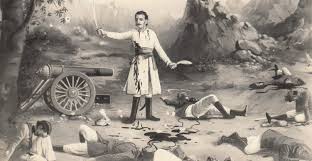
A Gorkhali military general, commander, and administrator in the Sikh Empire and the Kingdom of Nepal, Balbhadra Kunwar lived from 30 January 1789 to 13 March 1823. His military prowess in defending Nalapani Fort during the Anglo-Nepalese War (1814–1816) earned him widespread acclaim. As a captain in the Nepalese military, it was his responsibility to guard the Dehradun forts.
Name
His given name, Balabhadra, is the same as that of Krishna’s older brother, Baladeva (Balarama). It is a combination of two Sanskrit words: Bhadra (lit. “auspicious”) and Bala (lit. “strength”).
Early life and family
His father, Chandrabir Kunwar, lived in Bhanwarkot, Panchkhal Municipality, Kavrepalanchowk District, where he was born. His mother, Ambika Devi, was the daughter of Bada Kaji Amar Singh Thapa and the sister of Kaji Ranajor Thapa. His father, Chandrabir, was Ashiram Kunwar’s grandson and Jaya Krishna Kunwar’s son. In 1809 A.D., his brother Birabhadra Kunwar served as governor of Garhwal and military commander on the Kumaun and Kangra fronts.
Anglo-Nepal War (1814–1816)
Capt. Balbhadra Kunwar, who was in charge of the Gorkhali soldiers in Dheradun, was tasked with protecting the region. Since the middle to late 18th century, the Nepali/Gorkhali State had been enlarging its borders on all sides. These developments led to tensions with the British East India Company, and a war ensued.
With an army of 600 soldiers, including women and children, Capt. Balbhadra Kunwar retired to the strategic hill fort of Khalanga after realizing he could not hold the town of Dehradun against the British East India Company’s 3,000–3,500-strong stronghold. The British offered him the position of governor of the Western Garhwal if he surrendered or left Nepal, but he declined.
“Go capture the fort that you could not win by war, but now we have left it at our own will.”
Major General Sir Rollo Gillespie of the British army proceeded in October 1814 with 3,500 soldiers and eleven pieces of artillery to seize the Nepali territories that had been seized by the Nepali forces in the Gharwal and Kumaon districts between the Ganges and Yamuna rivers. To halt his march, Captain Balabhadra Kunwar had held his post atop a 400-cubit-high hill in the Nalapani area, northeast of Dehradun.
British troops arrived in Dheradun on Kartik 8, 1871, Bikram Samvat (October 1814). On Kartik 10, 1871 (B. Samvat), British and Nepali troops engaged in combat at Nalapani. After failing, the British retreated to Dehradun. The two sides engaged in combat once more at Nalapani on Kartik 17, 1871 Samvat (about OThe battle took place on October 31, 1814. Col. Alice and the British commander, General Gillespie, both perished in the conflict.
After a month of the siege, the British decided they could not win by force and cut off the fort’s water supply, causing the Nepalese to perish from starvation. It was a difficult battle for the Nepali Army against a sophisticated, highly skilled army that belonged to one of the world’s biggest colonial empires. Balbhadra Kunwar had requested reinforcements from the capital, but Kathmandu was unable to provide them with any troops because the Nepali army lacked a reserve army and was still a developing nation; therefore, they lacked the manpower to compete with the East India Company. As on the previous battlefield, the Nepalese army was outnumbered in Nalapani.
Despite the scarcity of water, the Nepali army steadfastly defended their position. British cannonballs began to enter the fort’s interior since the walls had fallen. Many men suffered injuries or lost their lives. Even after losing friends and allies, the remaining men remained steadfast in their commitment to their guns. The Nepali troops emerged from the fort in a single line to drink water from the river, and the British forces were shocked to see them quench their thirst and head back to their fort.
Four of the commanders, including Capt. Balabhadra Kunwar, were compelFour of the commanders, including Capt. Balabhadra Kunwar, were compelled to leave the fort of Nalapani with their surviving Gorkhali troops on the night of Marga 16 (November 1814), after the British witnessed their retreat from the fort. Despite their resistance, the Nepalis persisted in their advance. On the morning of MargOn March 17, 1871, they arrived at Dwara and spent the entire day there.
With the following letter, Balabhadra dispatched a courier to the British: At your request, we turned over your wounded and dead men to you. We now ask that you turn over our wounded warriors to us. In response, the British said they would take care of the wounded (Nepali) soldiers. At the Nalapani fort, they therefore provided medical care to the 180 wounded men.
The Nepalis chose to construct a fort on the Gopichand Hill; therefore, they left Dwara the following day, Marga 18, 1871 Samvat. Dwara wasn’t thought to be appropriate for that use.
The Gopichand hill was where the Nepalis stayed the night. The British army began bombarding their camp at midnight. The Nepalis struck back. Meanwhile, an enemy shell wounded Sardar Ripumardan Thapa in his right arm. His jamadar assisted him in climbing the hill because he was unable to walk. But he was unable to continue and had to quit. The other Nepalis kept going up the slope.
On Marga 19, 1871 B. Samvat, the following day, Balabhadra sent men to transport RipumardanAdditionally, Kaji Ranadipa Simha Basnyat had already arrived at Chamuwa. Enemy fire killed Subedar Dalajit Kanwar on Marga 20, the day Kaji Rewanta Kunwar arrived.
After four days of thirst and a significant loss of soldiers, Capt. Balbhadra and the remaining seventy survivors came from the fort with drawn kukris and yelled at the British, “You could have never won the battle, but now I myself voluntarily abandon this fort” The only thing inside the fort are the women’s and children’s dead bodies! On November 30, 1814, he fled into the hills with his surviving forces.
On December 2, 1815, the British East India Company and the then-King Girvan Yuddha Vikram Shah signed the Sugauli Treaty, a peace agreement.
Under Ranjit Singh, Maharaja
Balbhadra-themed stamp
The Anglo-Nepalese War did not claim his life. Following the war with the British, he traveled to Lahore, the capital of Punjab, where many Nepalis had fled, to enlist in the two new regiments established by Punjab’s Sikh Maharajah Ranjit Singh. This was a pre-war custom. General and commander of the new “Goorkha” regiments, which were composed solely of Gorkhali/Nepali soldiers, was Capt. Balbhadra Kunwar. Those who served under the Mughal emperors were referred to as “Munglane” and were regarded as extremely strong.
Death and Hari Singh Nalwa
The Nepalis in the Sikh military had fought valiantly during the Sikh-Afghan war of 1879 B. Samvat (1822), but on Chaitra 3 (March/April in the Roman calendar and the final month in the Hindu Lunar calendar), Balabhadra Kunwar was killed by Afghan artillery in Naushera, Peshawar region, Afghanistan. To gather information about this war and his nephew’s murder, Bhimsen Thapa had dispatched soldiers to Lahore. The legendary and renowned General Hari Singh Nalwa honored him during the war. Hari Singh Nalwa led the campaign, reaching as far as Jamrud.
In recognition of the Gorkhalis and Capt. Balbhadra Kunwar (often misidAfter the Anglo-Nepali War, the British East India Company built a war memorial at Nalapani to commemorate the valor of the Gorkhalis and Capt. Balbhadra Kunwar (often misidentified as Bulbuder Singh or Balbudder Thapa).