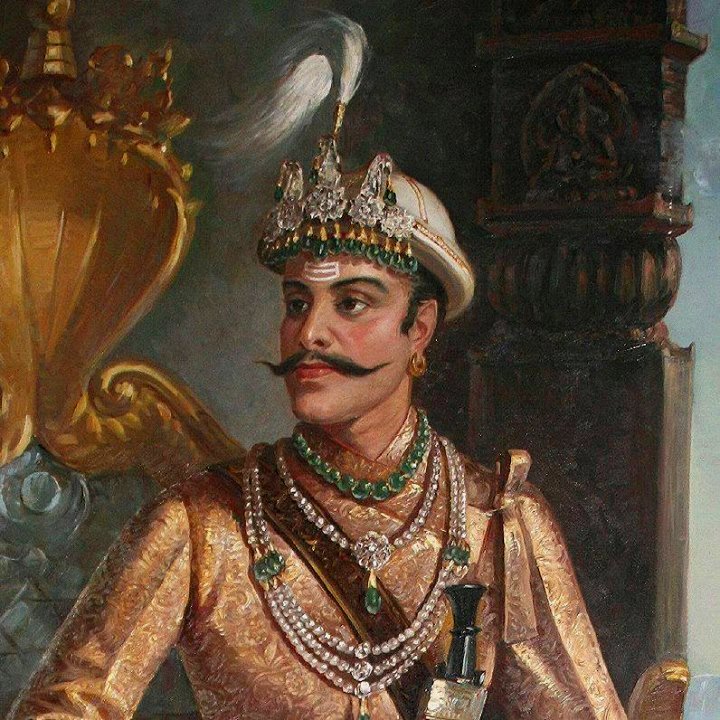
Following the death of his father, King Pratap Singh Shah, Rana Bahadur Shah (Nepali: श्री ५ महाराजाधिराज रण बहादुर शाह देव; 25 May 1775 – 25 April 1806) was King of Nepal. His mother, Queen Rajendra Rajya Lakshmi Devi (who passed away on July 13, 1785, from disease), and his uncle, Bahadur Shah, were his regents. Conquest during this period allowed the kingdom to grow to encompass the present-day Indian territories of Garhwal and Kumaon. He imprisoned his uncle Bahadur Shah, who later passed away.
Rule
The eldest son of Prithvi Narayan Shah, Pratap Singh Shah (reigned 1775–77), died too soon, leaving a massive power vacuum that persisted for decades and severely crippling the newly formed Nepalese state. Rana Bahadur Shah (1777–99), the son of Pratap Singh Shah, was two and a half years old when he succeeded his father. Queen Rajendralakshmi served as the acting regent until 1785, and then Bahadur Shah, the second son of Prithvi Narayan Shah, reigned from 1785 to 1794.
Instead of focusing on matters of national administration, court life was dominated by antagonism between these two regents, which created a negative precedent for future rivalry between competing regents. Bahadur Shah temporarily adopted a pro-British posture due to the demands of the Sino-Nepalese War (1788–1792), which resulted in a commercial pact with the British in 1792.
Rana Bahadur, on the other hand, had grown up in opulent splendor. When King Rana Bahadur Shah reached adulthood in 1794, his first action was to reorganize the government such that his uncle, Bahadur Shah, had no official role. He fell in love with Kantavati Jha, a Maithili Brahman widow, in the middle of 1795 and married her under an oath that excluded the rightful heir from his first marriage and made his illegitimate half-caste son the heir apparent in accordance with then-current Hindu law. His uncle, who had retired and sought asylum in China under the guise of visiting the new emperor, had become so estranged from him by 1797 that he arranged his detention (on February 19, 1797) and eventual murder (on June 23, 1797). Rana Bahadur gained notoriety for these deeds among courtiers as well as commoners, particularly Brahmins.
After Shah departed for Varanasi, Girvan Yuddha Bikram Shah was crowned king. Girvan Yuddha Bikram Shah was born in 1797 and was proclaimed the crown prince right away. However, Kantavati developed tuberculosis within a year after Girvan’s birth; doctors suggested that she cure herself by performing austere penances. To ensure Girvan’s succession while Kantavati was still alive, Rana Bahadur, who was only 23 years old at the time, abdicated on March 23, 1799, in favor of their son, appointing his first wife, Raj Rajeshwari, as regent.
Wearing saffron robes and referring to himself as Swami Nirgunanda, he began living at Deopatan and joined his second wife, Subarnaprabha, and his sickly wife, Kantavati, in leading an austere life. All of the courtiers, who were unhappy with his lustful and erratic actions, also backed this plan. Around this time, Bhimsen Thapa started working as the former king’s main bodyguard when he and his father, Amar Singh Thapa (sanu), were both elevated from subedar to the position of sardar. Rana Bahadur’s renunciation, however, was short-lived—just a few months.
Rana Bahadur had a mental breakdown following Kantavati’s unavoidable death, during which he viciously punished the attending doctors and astrologers and desecrated temples. After giving up his austere lifestyle, he made an effort to regain his regal power. This resulted in a direct confrontation with nearly every courtier who had sworn allegiance to the rightful King Girvan; this confrontation ultimately led to the creation of a dual government and the imminence of a civil war, in which Damodar Pande led the armed forces against the dissident former king and his group. Rana Bahadur was compelled to escape to the British-controlled city of Varanasi in May 1800 after realizing that his authority could not be restored because the majority of the military commanders had sided with the courtiers.
Varanasi exile: 1800–1804
Bhimsen Thapa traveled to Varanasi with Rana Bahadur Shah, who was his closest friend and counselor. Rajarajeshvari, Rana Bahadur’s first wife, was part of his entourage, while Subarnaprabha, his second wife, remained in Kathmandu to act as regent. Rebel factions in Varanasi centered around Rana Bahadur due to his unwavering determination to regain his authority and exact revenge on those who had forced him into exile.
He first turned to the British for assistance, agreeing to give them a portion of the tax income and a trading station in Kathmandu in return. But rather than take the chance of bringing an exiled former king back to power, the British preferred to cooperate with Nepal’s current government. The Kathmandu Durbar was prepared to negotiate a commercial pact to placate the British, provided that the renegade Rana Bahadur and his entourage were detained in India under close British supervision.
Rana Bahadur and his gang were furious with the British and Damodar Pande’s faction in Nepal when they learned of the treaty and the restrictions on their movement. To undermine the unity of courtiers at the Kathmandu Durbar and incite anti-British sentiment, a complex plot was initiated. Through a barrage of letters, the former monarch attempted to incite the courtiers against Damodar Pande and court them with the promise of prestigious government posts for the rest of their lives, which their descendants may inherit.
Disenchanted with her debauched husband, Rajarajeshwari left Varanasi and crossed the Nepali border on July 26, 1801, quietly moving toward Kathmandu in an attempt to seize control of the feeble regency. When Mul Kaji (or chief minister) Kirtiman Singh Basnet, a favorite of the Regent Subarnaprabha, was slain in secret on September 28, 1801, by Rajarajeshwari’s supporters, the court politics back in Kathmandu became difficult. Due to the ensuing turmoil, several courtiers were imprisoned, and some were put to death based only on hearsay.
Thereafter, Bakhatbar Singh Basnet, the brother of the killed Kirtiman Singh, was appointed mul kaji. During his time as mul kaji, on October 28, 1801, Nepal and the East India Company signed a Treaty of Commerce and Alliance, which resulted in the establishment of the first British Resident, Captain William O. Knox. On April 16, 1802, the courtiers in Kathmandu grudgingly welcomed him. Knox’s mission’s main goals were to create a “controlling influence” in Nepali politics and fully implement the trade pact of 1792. On December 17, 1802, Rajarajeshwari successfully assumed control of the regency, more than eight months after the establishment of the Residency.
Go back to Kathmandu
Following the regency’s transfer to Rajarajeshwari, Knox pressed her to fulfill the treaty’s terms by giving the former king an annual pension of 82,000 rupees, which settled the enormous debt that Rana Bahadur Shah had accrued in Varanasi as a result of his extravagant spending. Additionally, the Nepalese court believed that Rana Bahadur should remain isolated in Nepal rather than in British-controlled India and that settling his obligations would allow him to return when the time was right.
Her presence in Kathmandu also disturbed the courtiers gathered around Rajarajeshwari and Subarnaprabha. Sensing an impending conflict, Knox sided with Subarnaprabha and attempted to meddle in Nepal’s internal politics. When Rajarajeshwari learned of this situation, he dissolved the government and elected new ministers, including Damodar Pande as the mul kaji. Meanwhile, Resident Knox voluntarily left Kathmandu to live in Makwanpur, citing a cholera epidemic, after finding himself persona non grata and his mission’s goals unfulfilled. Members of Subarnaprabha’s faction were taken into custody.
Richard Wellesley, the governor-general at the time, unilaterally suspended diplomatic relations and called for Knox to return to India as a result of this overt display of humiliation and anti-British sentiment. On January 24, 1804, the British also unilaterally revoked the Treaty of 1801. The Governor General also used the suspension of diplomatic relations as an excuse to grant the former King Rana Bahadur an unconditional return to Nepal.
Rana Bahadur and his friends left for Kathmandu as soon as they heard the news. Kathmandu Durbar dispatched some troops to monitor their progress, but when the troops met the former king in person, they switched sides. At Thankot, where they were waiting to welcome the former king with state honors and place him in isolation, Damodar Pande and his men were taken into custody. Following his return to power, Rana Bahadur began to exact revenge on those who had attempted to keep him out.
Sher Bahadur Shah, his half-brother, beheaded him on April 25, 1806. The Bhandarkhal massacre followed the death of Rana Bahadur.
Very Informative Article