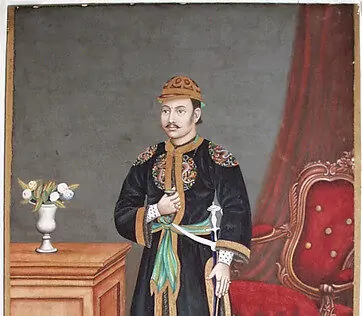
From August 1775 until July 29, 1839, Bhimsen Thapa (Nepali: भीमसेन थापा) was a Nepalese statesman who held the position of Mukhtiyar, or prime minister, and de facto ruler of Nepal from 1806 to 1837. He was named one of the “National heroes of Nepal” by King Mahendra Bir Bikram Shah and is renowned for being the country’s longest-serving prime minister.
In 1785, Bhimsen, who was born into a typical military family in the Gorkha Kingdom, had his first encounter with Crown Prince Rana Bahadur Shah. His father enlisted him as a bodyguard for the King in 1798. After assisting the exiled former King Rana Bahadur Shah in planning his ascent to power in 1804, he went on to become influential. As a token of appreciation, Rana Bahadur appointed Bhimsen a Kaji, or minister, in the new administration.
Following the assassination of Rana Bahadur by his stepbrother Sher Bahadur Shah in 1806, Bhimsen ordered the execution of ninety-three individuals, a case known as the 1806 Bhandarkhal massacre. He then claimed the title of Mukhtiyar, or prime minister, himself. With the help of Queen Tripurasundari, Rana Bahadur Shah’s junior queen, and the death of King Girvan Yuddha Bikram Shah in 1816 at the young age of 17, when his heir, King Rajendra Bikram Shah, was only three years old, he was able to hold onto power even after Nepal lost the Anglo-Nepalese War.
Following Queen Tripurasundari’s death in 1832, Bhimsen Thapa was imprisoned on false charges of killing an infant prince and later committed suicide in 1839 as a result of the intrigues of the newly adult King Rajendra, conspiracies, and internal strife with the British envoy Brian Houghton Hodgson, Senior Queen Samrajya Laxmi Devi, and rival courtiers (particularly the Kala Pandes, who blamed Bhimsen Thapa for Damodar Pande’s death in 1804).
Bhimsen’s actions to keep British authorities at bay and keep the Kingdom of Nepal from joining the British Empire through long and persistent anti-British politics during both wartime and peacetime are what make him famous. He was the first Nepalese statesman to fully understand the British system of protectorate in India, which was implemented by Lord Wellesley. During his time as prime minister, the Gurkha empire’s territory had grown to its maximum size, spanning from the Teesta River in the east to the Sutlej River in the west.
However, from 1814 to 1816, Nepal engaged in a catastrophic Anglo-Nepalese War with the East India Company, which was partially owned by the British Empire. The war ended with the Treaty of Sugauli, which cost Nepal nearly one-third of its territory. Many social, religious, economic, and administrative changes were implemented under his leadership, and the Nepalese Army was modernized using the model of the French armed forces. He ordered the building of numerous temples and monuments during his lifetime, including the well-known Dharahara, also called the Bhimsen Stambha (“Bhimsen Tower”).
Bhimsen is regarded as a patriotic, astute, and diplomatic politician who was crucial in protecting his nation from the then-pervasive British colonial empire in South Asia. He is widely regarded as one of the most important individuals in Nepalese history of the 19th century. Nationalism, rational national interest, and national sustenance were the main drivers of his foreign policy.
Along with his effective systematization and management of the state administration, programs, and policies, he is widely regarded as a reformer. His early political career was marred by a horrific political massacre, the eradication of his political opponents, and the concentration of political and military power within his family.